Mileage allowance scale: automatic calculation of your reimbursements
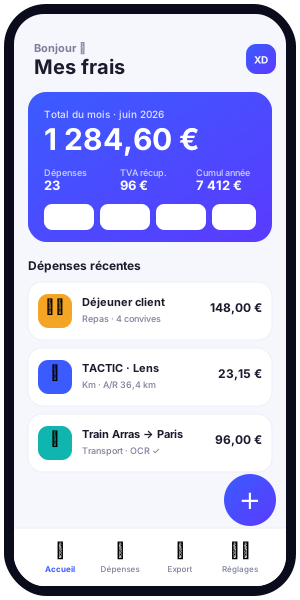
Every year, millions of employees, company directors and freelancers use their personal vehicle for business travel. To be reimbursed without tedious calculations and without the risk of errors, they rely on the mileage allowance scale. But between the vehicle's fiscal horsepower, the mileage brackets, the retroactive effect beyond 5,000 km, the surcharge for electric vehicles and the different scales from one country to another, manual calculation quickly becomes a headache. Kwevio, the free business expense management app created by FACEM WEB (Arras), fully automates this work. This page explains step by step how the mileage allowance works and how Kwevio calculates fair and justifiable mileage expenses for you in just a few seconds.
What is a mileage allowance and who is concerned?
A mileage allowance is a flat-rate reimbursement intended to cover the costs of using a personal vehicle for business purposes. It is not limited to fuel: it also includes vehicle wear (depreciation), maintenance, repairs, tyres, insurance and, in some countries, part of the financial costs. This is precisely why a simple "reimbursement at the pump" is not enough: the mileage scale offers a global, flat-rate estimate of the real cost of a kilometre driven.
Many profiles are concerned by this mechanism:
- Employees who travel to clients, to worksites, between several offices or for occasional assignments.
- Directors and managers who use their personal car for their company's activity.
- Freelancers, liberal professions and self-employed people who may, depending on their tax regime, deduct their actual travel expenses.
- Volunteers and association officers who incur expenses on behalf of an organisation.
In every case, the logic is the same: you need to know the distance actually travelled, apply the scale corresponding to the vehicle's fiscal horsepower (in France) or the country's per-kilometre rate, and keep a record for any audit. Kwevio handles these three steps from end to end.

How Kwevio calculates distance
The first source of error in an Excel spreadsheet is distance. Many users record a rough "from memory" estimate, round it up, or copy a figure from a previous trip. Kwevio removes this uncertainty by automatically calculating the real road distance.
A calculation based on OpenStreetMap
Kwevio relies on the open mapping data of OpenStreetMap, via the OpenRouteService routing engine. You enter a starting address and a destination address, and the app calculates the most relevant road distance — the one a vehicle actually drives on the road, not a straight-line distance. The result is consistent, reproducible and easy to verify.
One-way or round trip
For each trip, you indicate whether it is a one-way journey or a round trip. With one click, Kwevio doubles the distance for round trips, without you having to do the multiplication yourself. No more classic mistakes where the return leg is forgotten, or accidentally doubled.
A variable starting point
Not all trips start from the same place. One day you leave from home, the next from the company's head office, sometimes from a client site. Kwevio handles a variable starting point: you choose the origin address for each trip. This flexibility matches real-world conditions and avoids distorting annual totals by freezing a single starting point for all journeys.
In practice, this automatic distance calculation saves you considerable time every day. Where, in a spreadsheet, you had to open an online mapping service, copy the distance, paste it, choose the rounding and then start again for each trip, Kwevio does it all in a single entry. You type the addresses, and the app immediately displays the mileage and the corresponding amount. This fluidity also encourages you to declare your trips as you go rather than at the end of the year, which reduces the risk of omissions and improves the reliability of the annual totals used to calculate the brackets.
The French scale by fiscal horsepower (CV)
In France, the mileage scale for cars is based on the vehicle's fiscal horsepower, expressed in fiscal horsepower units (CV). The higher the power, the higher the flat-rate cost per kilometre, because operating costs are assumed to be higher. The scale distinguishes several power categories, generally from 3 CV or less up to 7 CV and above.
As an indication (base 2025 coefficients, for the bracket up to 5,000 km), the per-kilometre values are roughly:
- 3 CV and below: around €0.529 / km
- 4 CV: around €0.606 / km
- 5 CV: around €0.636 / km
- 6 CV: around €0.665 / km
- 7 CV and above: around €0.697 / km
These amounts are indicative and given on a 2025 basis: they must be checked against the official scale for the current year, as they are revised regularly. In Kwevio, you enter your vehicle's fiscal horsepower once, and the app automatically selects the right line of the scale for all your calculations. You no longer need to find the official table, identify the right column or risk a reading error.
The fiscal horsepower appears on the vehicle's registration document (field P.6 of the French registration certificate). It mainly depends on engine capacity and emissions, not on the real power in DIN horsepower. The same car may therefore fall into a different scale category than you would intuitively assume: it is essential to start from the official value. Kwevio lets you enter this power precisely for each vehicle, which guarantees that the right coefficient — and therefore the right mileage allowance amount — is always applied.
The 3 mileage brackets and the retroactive effect beyond 5,000 km
This is the most misunderstood point of the French scale — and the most frequent source of error in spreadsheets. The scale is not just a single price per kilometre: it is organised into three annual mileage brackets:
- Bracket 1: up to 5,000 km driven in the year
- Bracket 2: from 5,001 to 20,000 km
- Bracket 3: beyond 20,000 km
The retroactive effect: the trap to understand
Many people think the second bracket formula only applies to kilometres above 5,000 km. That is false. When you exceed 5,000 km in the year, the formula of the corresponding bracket applies to the entire annual distance, not just the excess. There is therefore a retroactive recalculation of all the kilometres already driven.
Concretely, the second bracket formula takes the form: (distance × coefficient) + fixed amount. For a 5 CV vehicle, for example, it reads: distance × 0.357 + 1,395, where the distance is the annual total.
Worked examples
Let's take a 5 CV vehicle and observe the impact of the brackets:
- 4,000 km in the year (bracket 1): the first bracket coefficient applies: 4,000 × 0.636 = €2,544.
- 6,000 km in the year (bracket 2): we switch to the second bracket formula, applied to all kilometres: 6,000 × 0.357 + 1,395 = €3,537.
- 15,000 km in the year (bracket 2): 15,000 × 0.357 + 1,395 = €6,750.
It is clear that going from 5,000 to 5,001 km does not cause a drop in reimbursement: the formula with a fixed amount is precisely designed to ensure continuity. But the calculation changes its logic entirely, and this is exactly where Excel spreadsheets make mistakes, either by applying the new formula only to the excess, or by forgetting the fixed amount.
Kwevio handles this retroactive recalculation automatically: as your annual kilometres increase, the app monitors threshold crossings and recalculates your entire allowance with the right bracket, with no action on your part. You always see a consistent and compliant amount.
This mechanism has a practical consequence that is often overlooked: as long as the year is not over, the allowance amount for a given trip is not fixed. A trip made in January will be valued according to bracket 1 at the start of the year, then revalued according to bracket 2 if, in November, your annual total exceeds 5,000 km. This is perfectly normal and compliant with the scale, but it makes any manual tracking particularly tricky. Kwevio constantly displays the up-to-date amount, recalculated according to the current annual total, which spares you any nasty surprises when finalising your declaration.
Electric vehicles: the 20% surcharge
To encourage clean mobility, the French scale provides a 20% surcharge on the mileage allowance amount for electric vehicles. This surcharge applies to the result obtained after the standard scale has been applied.
Let's take the example of the 5 CV vehicle driving 6,000 km again. The base calculation gives €3,537. With the 20% surcharge for an electric vehicle: 3,537 × 1.20 = €4,244.40. In Kwevio, you simply indicate that the vehicle is electric: the surcharge is applied automatically, across all brackets, with no additional calculation on your part.
Several vehicles and a change during the year
Real life is rarely as simple as a frozen spreadsheet. You may change cars during the year, own several vehicles, or see the fiscal horsepower change. Yet each vehicle has its own scale and, above all, its own bracket counter.
Kwevio natively handles multi-vehicle tracking:
- You register several vehicles, each with its fiscal horsepower and possible electric status.
- For each trip, you indicate which vehicle was used.
- The app tracks kilometres bracket by bracket and applies the right scale to each vehicle.
This per-vehicle tracking is essential to stay accurate when the fiscal horsepower changes during the year. Doing this manually in Excel requires keeping several columns, several conditional formulas and monitoring the thresholds for each vehicle — a task as long as it is risky. Kwevio takes care of it silently.
The scales of other countries
Kwevio is multilingual and multi-country. Reimbursement rules differ greatly from one country to another: some use a single per-kilometre rate, others use brackets, and others use detailed tables by vehicle. Here is an overview of the main scales taken into account (indicative amounts, 2025 basis, to be updated each year).
United Kingdom
The HMRC scale works with two tiers: 55p per mile up to 10,000 miles, then 25p per mile beyond. The reasoning is done in miles rather than kilometres, which Kwevio handles without any manual conversion on your part.
Germany and Luxembourg
These two countries apply a rate close to €0.30 / km, simple and flat-rate, without brackets comparable to the French system.
Belgium
Belgium uses a rate of around €0.4259 / km, regularly indexed. Kwevio applies the indicative value in force, to be confirmed according to the official indexation for the year.
Spain and the Netherlands
Spain is around €0.26 / km and the Netherlands around €0.23 / km, again on a flat per-kilometre basis.
Switzerland
In Switzerland, the rate is around 0.75 to 0.76 CHF / km, expressed in Swiss francs.
Italy
Italy is based on the ACI tables, which detail the per-kilometre cost according to the precise vehicle model. It is the most granular system, and Kwevio relies on this logic to provide a consistent estimate.
All these amounts are indicative (2025 basis) and must be checked against the official scale of the relevant country and year.
For a multinational team, or simply for someone who travels across borders, this multi-country support removes a real burden. There is no need to maintain one spreadsheet per country, to remember which rate applies where, or to convert miles into kilometres by hand for the United Kingdom. You select the relevant scale, and Kwevio applies the right unit, the right rate and, where applicable, the right tiers — keeping every trip aligned with the local rules.
Why it is more reliable than a spreadsheet
Kwevio was born from a simple observation: to replace an Excel mileage expense spreadsheet that had become too fragile. The spreadsheet was long the default tool, but it accumulates sources of error:
- Approximate distances: entered from memory, rounded, or copied from one trip to another.
- Broken formulas: one deleted cell, one shifted reference, and the whole total is wrong.
- Mishandled brackets: forgetting the retroactive effect beyond 5,000 km, the wrong fixed amount, or applying the formula only to the excess.
- Forgotten electric surcharge or applied in the wrong place.
- Unmanageable multi-vehicle tracking: multiplying columns and bracket counters that are impossible to follow.
With Kwevio, mileage calculation, scale application, bracket management, retroactive recalculation and the electric surcharge are all automated. The tool applies a single, tested and consistent logic to all your trips. You save time and, above all, you gain peace of mind in the face of a possible audit.
Beyond calculation errors, the spreadsheet also raises a durability problem. An Excel file gets lost, corrupted, exists in several contradictory versions on different machines, or becomes unreadable when the person who designed it leaves the company. Kwevio centralises your trips in an app designed to last, accessible from your smartphone as well as from a browser thanks to the installable web version (PWA). Your data follows you, stays consistent and is structured from the outset to produce clean supporting documents.
Export and justification
A correct calculation is only worth it if it can be justified. For each trip, Kwevio keeps the key elements: date, starting and destination address, calculated distance, trip type (one-way or round trip), vehicle used and the allowance amount applied. You thus have a clear history, usable to produce your expense reports, feed your accounting or respond to an administrative request. The traceability of the distance calculation via OpenStreetMap strengthens the credibility of your supporting documents: each distance is reproducible and verifiable.
FAQ
Does the mileage scale change every year?
Yes, the official coefficients are revised regularly. The amounts presented here are indicative (2025 basis) and must be checked against the official scale for the current year.
The retroactive effect beyond 5,000 km, how does it work?
As soon as you exceed 5,000 km in the year, the second bracket formula applies to all your annual kilometres, not only those above the threshold. Kwevio automatically recalculates the whole amount.
Can I use several vehicles?
Yes. Kwevio handles several vehicles with different fiscal horsepower and tracks the brackets independently for each.
Does Kwevio work outside France?
Yes, the app is multi-country and takes into account the scales of the United Kingdom, Germany, Luxembourg, Belgium, Spain, the Netherlands, Switzerland and Italy, among others.
Is Kwevio really free?
Yes. Kwevio is a free app, available on Android, iOS and as a lightweight installable web version (PWA). There is no paid tier hiding the core mileage features behind a paywall.
Where does the distance calculation come from?
Distances are computed from the OpenStreetMap data set through the OpenRouteService routing engine, based on the start and destination addresses you enter. The result reflects the real road route, so it is consistent and easy to verify if anyone questions a figure.
Conclusion
The mileage scale is more complex than it seems: fiscal horsepower, three brackets, the retroactive effect beyond 5,000 km, the electric surcharge, multi-vehicle tracking and country-specific rules. Calculating it by hand in a spreadsheet exposes you to costly errors. Kwevio automates everything: real road distance via OpenStreetMap, selection of the right scale, bracket and retroactive recalculation management, electric vehicle surcharge and multi-vehicle tracking. Free, multilingual and multi-country, the app turns an annual chore into a few reliable and justifiable clicks.
Ready to ditch your mileage expense spreadsheet? Try Kwevio for free.