Reclaiming VAT on your expense reports is an often-underused cash-flow lever, for want of method and records. Every business expense paid inclusive of tax contains a slice of VAT that can, under conditions, be deducted and returned to the business. But you still need to know which items qualify, hold compliant invoices, and compute the recoverable share without mixing up the rate. Many freelancers and small firms let these amounts slip away — not by choice, but because gathering the evidence and doing the maths feels too heavy day to day. This article covers the whole question, from the general principle to the mistakes that cost the most.
Which expenses allow you to reclaim VAT?
The base rule fits in one sentence: VAT is deductible when an expense is incurred for the needs of the business and backed by a compliant invoice. But that general rule has many exceptions, specific to each type of spend. Managing expenses by category is precisely what helps separate what qualifies from what is excluded, because reasoning item by item is the only way to avoid errors. Some expenses are largely deductible, others only in part, others not at all, and the line is anything but intuitive: it stems from regulatory choices you cannot guess from common sense. The table further down sums up the most common cases.
Meals and entertaining
VAT on meal expenses incurred in a business context is, in principle, recoverable, provided the spend is justified, proportionate and documented. For a business meal with guests, the practice is to note the reason and the list of attendees, which clearly strengthens the justification if questioned. The invoice must show the VAT separately: a plain till receipt with no tax breakdown, or an unreadable slip, weakens the deduction and may be enough to overturn it. It is on this very frequent item that documentary rigour pays off most, because meals add up quickly over a year.
Accommodation and travel
The rules tighten on accommodation and passenger travel. VAT on hotel nights for the business owner or employees is generally not recoverable, whereas it can be in some cases for third parties. On passenger travel — train, plane or taxi — VAT is most often not deductible either. These exclusions, which always surprise, stem from choices specific to the regulation rather than from any obvious economic logic. That is exactly why you must never assume an item is deductible: what looks like an ordinary business cost may simply not give a right to recovery.
Fuel and vehicles
Fuel follows specific rules that vary by vehicle and fuel type, with partial deduction rates that have shifted over recent years toward gradual alignment. The principle remains conditional deductibility, never automatic, and servicing or vehicle purchase follow their own logic. Faced with this moving complexity, the official documentation and your accountant remain the references to consult, especially as these percentages can change from one year to the next. At your level, the key is to keep the invoice and leave the exact-rate question to the right people, rather than applying a remembered approximate figure.
| Type of expense | VAT recoverable? |
|---|---|
| Business meal | Yes in principle, with an invoice showing VAT |
| Accommodation (owner, employees) | Generally no |
| Passenger travel (train, plane, taxi) | Most often no |
| Fuel | Partial, by vehicle and fuel type |
| Supplies and small equipment | Yes, with a compliant invoice |
How do you calculate recoverable VAT from the gross amount?
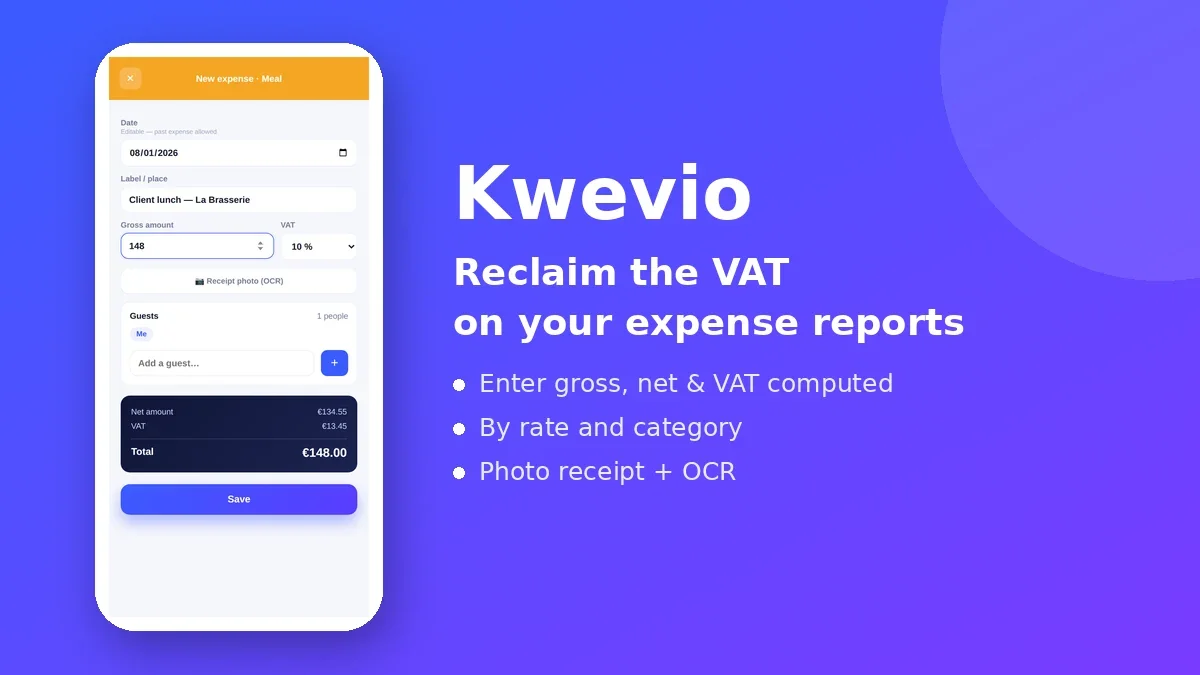
Once deductibility is settled, you still have to isolate the tax within the spend. From a gross, tax-inclusive amount, you work back to the net amount, then derive the VAT by applying the rate in force. The operation is simple per item but quickly becomes tedious and error-prone across a year of varied spending. A expense-report app does this instantly as soon as you enter the gross amount and the rate, then accumulates recoverable VAT over the period and by rate. You avoid manual additions, rounding errors and omissions, while always having a total ready for the return.
From gross to net
Moving from gross to net means dividing the tax-inclusive amount by one plus the rate: for instance by 1.10 for a 10% rate, or by 1.20 for a 20% rate. The difference between gross and net gives the VAT. On a €148 meal at 10%, the net comes to €134.55 and recoverable VAT to €13.45. Immediate for one line, this becomes tedious once repeated across hundreds of receipts at different rates — and that is exactly where assisted entry makes the difference between tracked VAT and lost VAT.
The different rates
You still have to apply the correct VAT rate to each expense: the standard rate, an intermediate rate used notably on catering, or a reduced rate depending on the case. Mixing rates distorts both the recoverable amount and the breakdown the tax office expects. The habit that saves you is to record the rate at the moment of entry, rather than trying to reconstruct it later from a total. You then get a reliable running figure and a correct breakdown by rate, directly usable for the return, without reopening each receipt to guess which rate applied.
Tracking the running total
Tracking the recoverable VAT total month by month, then over the year, gives a clear view of what the business can actually reclaim. This tracking only has value if it is kept as you go and systematically tied to retained records. A dashboard showing the VAT recovered this month and the year's running total turns a purely administrative constraint into steering information: you know where you stand at any time, you anticipate, and you no longer discover at year-end an amount you could have reclaimed sooner. That shift, from accounting endured to tracking chosen, changes your whole relationship with VAT.
What records do you need to deduct VAT?
Without a compliant record there is no possible deduction: it is the cardinal rule, the one that sinks the most otherwise legitimate recoveries. Automatic receipt reading greatly eases collection by extracting the amount and date from a simple photo, but the evidential value still rests on the invoice itself and the details it carries. In other words, the technology speeds up entry and limits losses, but it does not replace the original document: it is the organisation of the evidence, as much as its capture, that determines how solid the whole thing is.
The compliant invoice
To reclaim VAT you need a compliant invoice, showing in particular the net amount, the rate and the VAT amount, along with the supplier's identity and, above certain thresholds, the customer's. A brief till receipt may do for small amounts, but it is more fragile than a detailed invoice. The good habit is to check that VAT appears on the document at the very moment of the spend: that is when — not three months later — you can still ask the merchant for a compliant invoice, before the receipt fades or vanishes into a pocket.
The receipt photo and OCR
Photographing the receipt as soon as you buy, and letting OCR pre-fill the amount and date, cuts both omissions and lost slips — the leading cause of unclaimed VAT. Attached to the expense, the photo then travels with it all the way to the accounting export, with no extra handling. This simple gesture, made in the field while you still hold the receipt, saves hours of month-end searching and secures the justification of every line. It turns a scattered chore — juggling dozens of paper scraps — into an instant, centralised action.
Digital retention
Digital retention of records, provided it is faithful and durable, is now accepted and far more practical than paper archiving. The key is to be able to find each piece of evidence, tie it unambiguously to its expense, and export it on demand. Organised, backed-up, dated storage is the best insurance against a request for justification: you present a complete, orderly file instead of digging through incomplete folders. It is also what lets you, when the time comes, hand everything to an accountant without spending a day on it, each record already tied to the right line.
Common mistakes with expense VAT
A few recurring mistakes wipe out the benefit of the deduction, even though they are easy to avoid with a little method and the right tool. Spotting them is already half the fix.
Assuming deductibility
The first mistake is to assume deductibility without checking the rule specific to the item. Accommodation and passenger travel are the classic traps: out of habit you reclaim VAT that is not recoverable, exposing yourself to a challenge and a claw-back. Sorting by category, knowing each one's regime, avoids that misstep; when in doubt, it is better to refrain from reclaiming and ask your accountant than to correct a whole return built on a mistaken assumption.
Losing the record
The second mistake is to lose the record or let it go missing. VAT that is perfectly deductible in principle simply becomes unrecoverable without a compliant invoice: the right exists, but you can no longer exercise it. Capturing the evidence immediately, as soon as the spend is made, rather than relying on memory or a month-end sort, is the only truly effective cure for this silent leakage which, added up over a year, represents far from negligible sums for a small structure.
Mixing up rates
The third mistake is to mix up rates, or to enter a net amount instead of the gross, or the reverse. The error distorts the VAT calculation, then the running total, and propagates all the way to the return where it becomes hard to trace. The remedy is mechanical: always record the gross amount actually paid and the exact rate on the invoice, then let the tool compute the net and the VAT. You remove a whole class of errors at the source, instead of hunting them down one by one much later, when the original record is no longer in front of you.
Articles similaires
2026 mileage allowance: rates and calculation
2026 mileage allowance: understand the rate by fiscal power, the distance brackets, the electric top-up and a worked exa…